
Cosmic Inflation
Fact or fiction?


Peering into the first moments of creation is no easy task. There are numerous theories that lay out a description of the very early universe, fractions of a second after the beginning. However, the farthest back we can actually observe is about 380,000 years after the Big Bang.
This is the Cosmic Microwave Background (CMB), serendipitously discovered in 1964 by American radio astronomers Arno Penzias and Robert Wilson. It is a diffuse glow of microwave radiation pervading all of space.
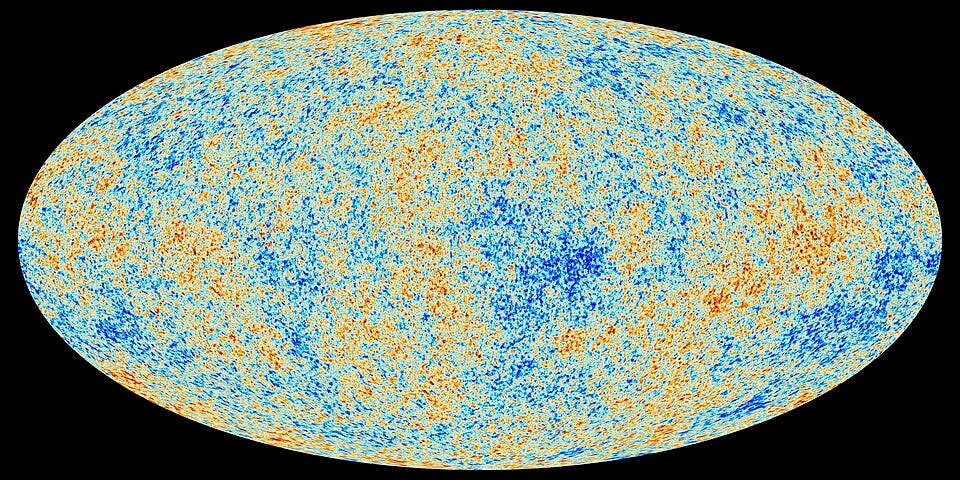
Prior to the formation of the CMB, the universe was a hot plasma that trapped photons through electromagnetic interactions; a plasma, of course, consists of electrostatically charged particles in rapid motion.
Only after 380,000 years did the so-called era of recombination begin, where temperatures cooled enough for protons and electrons to form neutral atoms, in turn, allowing photons to travel freely. These are the photos we can study today as the CMB which can also be referred to as The Horizon of Last Scattering.
There may be signals dating back to before the CMB in the form of neutrinos or gravitational waves which can penetrate plasma more easily than photons. For the very same reason, however, both neutrinos and gravitational waves are difficult to detect, making the collection of sufficient data a daunting endeavor.
Nonetheless, there are many qualities of the CMB that raise questions worthy of further research. In particular, it has complicated the orthodox initial conditions of the Big Bang model.
