Prime Mover
The physical genesis of causality
When one speculates on the creation of the universe, quandaries and paradoxes abound. Notwithstanding the concept of a multiverse, the universe appears to be all that is—endless light-years of stars, dust, and interstellar voids. What could have brought the cosmos into existence if it already contains everything?
Without the veil of mysticism or religion, such a question seems utterly impenetrable. Even posing it could be a foolhardy endeavor.
The daunting nature of the problem, however, has only served as motivating fuel for some of history’s greatest intellects. In a previous post, we talked about one attempt to resolve the mystery of existence in the writings of Gottfried Leibniz. Yet, his arguments borrow many presuppositions from a long line of thinkers going all the way back to antiquity. Chief among them was the great Aristotle.
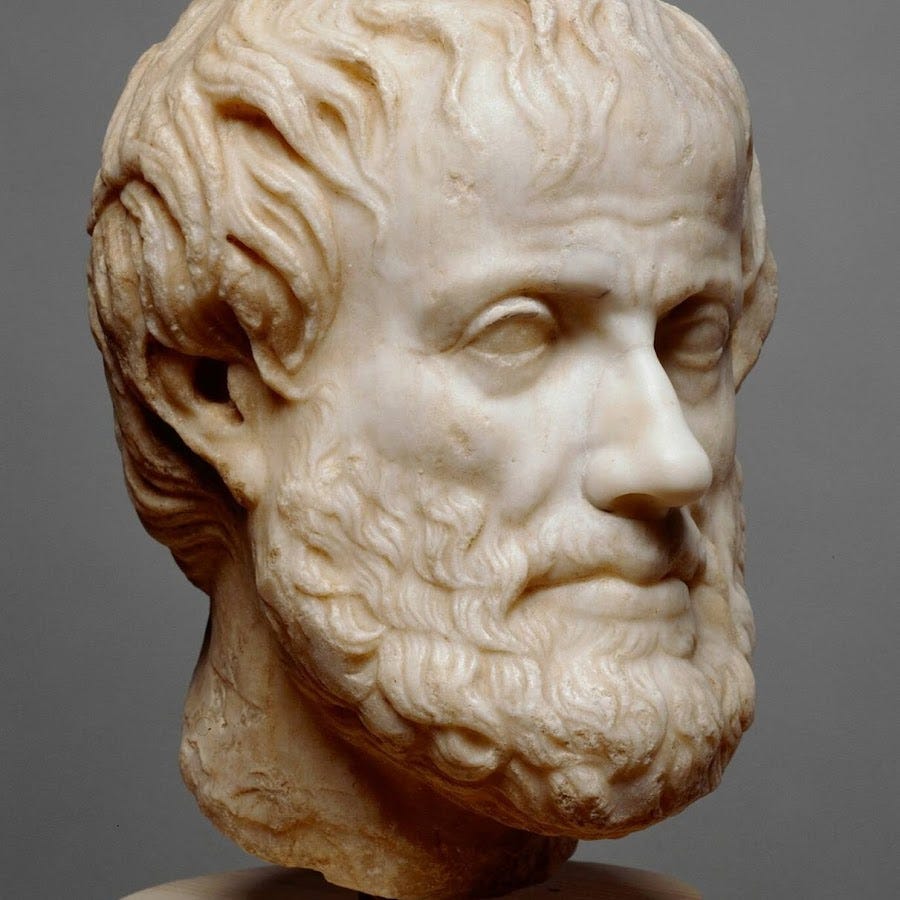
In this regard, he is best known for founding the idea of an unmoved mover who would be responsible for initiating all motion in the universe while remaining unmoved. In Book VII of Aristotle's Physics he asserts,
Since everything that is in motion must be moved by something, let us take the case in which a thing is in locomotion and is moved by something that is itself in motion, and that again is moved by something else that is in motion, and that by something else, and so on continually: then the series cannot go on to infinity, but there must be some first mover.1
While this may seem like a straightforward argument, we must go deeper into the terminology of Ancient Greek philosophy to truly grasp what is being said here. For Aristotle, movement meant much more than simply a translation of position through space, though it can also encompass this signification.
Broadly speaking, motion referred to any sort of change whatsoever. The ripening of a fruit or the growth of a boy into adulthood is a type of motion in this sense.
At the core of Aristotle’s interpretation is a transition from potentiality to actuality. If one throws a stone, for instance, the potential of the stone to be a certain distance away gets actualized. But, in order for this change to occur the potentiality must be actualized by something already actual, namely the thrower. Likewise, a caterpillar contains within it the potential to become a butterfly and actualizes it in steps through various stages of metamorphosis.
Aristotle then reasons that a causal chain can be formulated for any observed motion stretching backward into the past. Whatever started off the entire succession cannot be something ordinary that is itself capable of change as it would be caught up in the infinite regression of causes. Thus, the unmoved mover must not have potentiality as an aspect of its constitution; the unmoved mover must be something that is wholly actual at all times.
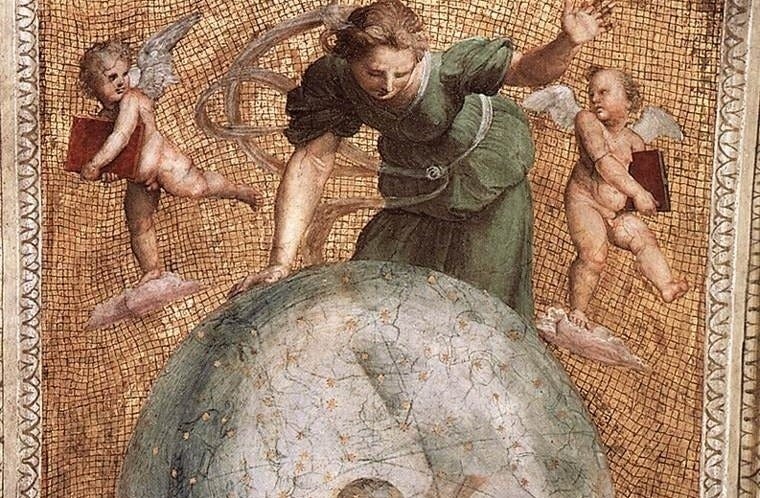
Aristotle arrived at these conclusions through his extensive work on Astronomy. For him, reality was divided into two spheres of celestial objects. The outer sphere consisted of fixed stars whose positions remained relatively unchanged night after night while the inner sphere corresponded to the so-called “wandering stars” which moved in periodic orbits. These were, of course, the numerous planets visible from Earth like Mars and Venus.
A prime mover would be what sets the celestial realm into motion harmoniously and would itself have to be immaterial as anything made of a particular substance can be acted upon and therefore has the capacity to change.
It is easy to see how these propositions run in parallel with our discussion of Leibniz who asserted that a supernatural God was what held together causality as a coherent concept on the largest scale. The notion of an unmoved or prime mover has been carried, often unconsciously, through millennia of philosophical thinking.
The extent to which Aristotle associates such a being with God, though, is unclear. It seems, at face value, that the only function of a prime mover would be to maintain the process of change throughout the universe. But just as with Leibniz’s arguments, it is difficult to arrive at concrete properties for such an entity through logic alone.
Aristotle’s unmoved mover formed the basis of what later came to be called the Cosmological Argument which was most notably pursued by the scholastic philosopher and Catholic priest, Thomas Aquinas. He incorporated numerous principles from classical philosophy into his theology, his main objective being to reconcile faith and reason within the medieval Catholic Church.
To put it briefly, Aquinas saw both faith and reason as simply different ways of accessing truth. Faith in the Gospels is required to know of the life of Christ and the circumstances of his resurrection, but whether or not there is a God should be ascertainable through one’s faculties of reason alone.
Aquinas explicitly connected the concept of a prime mover with the Christian God in his work, Summa Theologica.2 He sketches out five proofs of God’s existence:
1. The Argument from Motion – Movement is apparent everywhere in the world. Anything in motion was put in motion by some other object. If this sequence extends back to infinity, however, there would be no first mover by definition and hence no subsequent movement would be possible. Aquinas maintains that God can be understood as the agent responsible for starting off the processes of change manifest in the universe.
2. The Argument from Causation – Nothing is known to be the cause of itself. Aquinas assumes this principally because it would imply an object existing prior to its own creation which he deems preposterous. The character of time demands that causes can be traced indefinitely far into the past, but without an initial cause there would be no successive effects. There thus must be an uncaused first cause which is God.
3. The Argument from Contingency – Things in nature can exist or not exist at any particular moment. This means that there could have been a time at which there was absolute nothingness. However, in such a scenario it would be impossible for anything to begin to exist. The truth of being stipulates an entity that must exist at all times. Objects have contingent existence, but God has necessary existence.
4. The Argument from Gradation – Every conceivable property comes in degrees. For each class of beings, there must be a quintessential example against which everything else is measured. A thing that is brighter more closely resembles that which is the brightest, for instance. Humans are capable of immense acts of both good and evil; people are good to different degrees. Aquinas thus believed that there must be a perfect being that reflects the highest degree of goodness.
5. The Argument from Design – Everything has its own purpose or end. Natural bodies move through space in a predictable pattern and life forms seem to have characteristics that lead them towards particular goals. Aquinas believed that this pointed to a divine intelligence responsible for designing the various aspects of the world so that each one is guided toward a specific aim.
Aquinas’ philosophy adopts the interpretation of nature as ens creatum, created thing. Reality exists only insofar as it references a creator both with regard to that creator’s innate qualities or his intentions.
This framing is not at all foreign to the Judeo-Christian mindset which understands mankind as explicitly made in the image of God. It seems only obvious to assume that the meaning of existence therefore is to serve God’s will and comport oneself according to his laws.
Still, for the modern man of science all these points are suspicious. Is the aim of Aquinas really truth or has he already made up his mind before even starting the argument?
This is why for a long time cosmologists just assumed that the universe was eternal. If an infinite causal regress into the past seems absurd, that’s too bad. Reality is under no obligation to conform to our philosophical word games. Unless evidence says otherwise, we should keep our scientific models as simple as possible.
Fortunately for the theologians, that evidence soon came. With the formulation of General Relativity and more sensitive astronomical observations in the first half of the twentieth century, the Big Bang Theory was developed. All signs point to the fact that the universe is expanding and emerged from a dense plasma 13.8 billion years ago—lending credence to the idea that the universe is not eternal, but rather finite with respect to the past.
Here we must be careful. What we are really observing is the horizon of last scattering: the moment at which the universe cooled down enough for photons to travel freely instead of being trapped in the high-temperature plasma which filled all of space. The cosmic microwave background is the imprint of this transition. It is reasonable to conclude that the universe was even denser before this time, but the classical equations of General Relativity can’t be extended indefinitely to t = 0.
A new theory of quantum gravity is widely assumed to come to the fore at this juncture. We will refrain here from giving a full critique of the viability of such a theory, but isn’t it interesting that quantum mechanics appears to become essential to our description at the moment of genesis? Is there an inextricable connection between a correct interpretation of quantum mechanics and the mystery of existence? And, what role does gravity in the form of spacetime curvature play in the problematic of causality?
To be sure, there are models in quantum cosmology which allow for a universe that is more or less eternal such as the Big Bounce Model or the Eternal Cyclical Cosmology of Roger Penrose. These are convenient in that they allow us to forget about that pesky prime mover.
But, it’s hard not to simply see these paths as a cop-out. The stimulus behind physics research is to work out a fundamental understanding of reality. How then could we shirk away from a fundamental first cause, a cause that would explain how the universe came into existence?
If we hope to ever make substantial headway on this front we must restrain our analysis to purely physical considerations. What we know from the cosmic microwave background is that the universe began in a state of striking uniformity. Unlike a thermal gas which spreads its temperature out over time, gravity clumps things together into concentrated pockets. The universe seems to have begun in an incredibly improbable low entropy configuration gravitationally—almost as if it were designed somehow. This may ultimately be the source of the arrow of time to begin with.
The theory of cosmic inflation presents an explanation for these observations by proposing a phase of exponential expansion in the early universe, but the process falls short of describing the universe’s creation. We have now arrived at the very frontiers of physics and it is difficult to judge between a multitude of theoretical considerations where experimental data is scarce.
A more accurate model of nature may be required to bridge the gap, one that incorporates a more robust understanding of spacetime and energy. Perhaps the prime mover we’ve been seeking is not some special entity that transcends reality, but rather a unique and primal state of matter.
Aristotle, Physics, Book VII Da Jonathan Barnes, editor, The Complete Works of Aristotle. The Revised Oxford Translation, Vol. 1, 1991.
The Physics is a collection of treatises written by Aristotle in the fourth century BCE. Its title stems from the Greek word physis, meaning nature. The treatise divides roughly into two main parts. Books I–IV are an inquiry into the essence of nature which Aristotle defines as
a principle or cause of being moved and of being at rest in that to which it belongs primarily, in virtue of itself and not accidentally.
In other words, nature is an innate tendency of motion or change within an object.
Books V–VIII cover Aristotle’s understanding of motion. He asserts that things can undergo change in four conceivable respects: quantity, quality, place, and substance. It is also here that Aristotle introduces the concept of a prime mover
The Summa Theologiæ of St. Thomas Aquinas Second and Revised Edition, translated by Fathers of the English Dominican Province, 1920.